AI and Cinema: What Future?
AI Confidential · June 4, 2025 · by Sergio & Nox
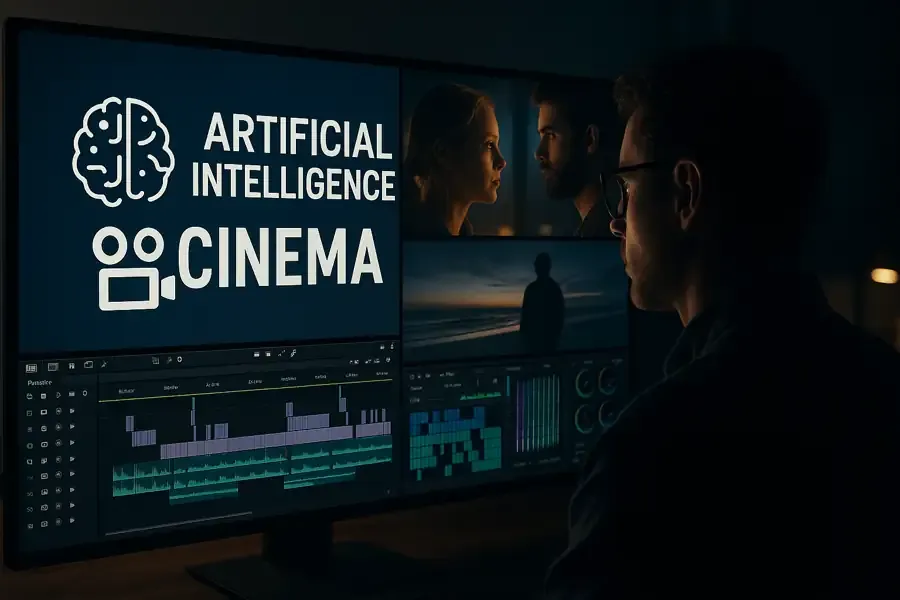
How artificial intelligence is transforming cinema
In 2025 cinema is no longer what it used to be. Artificial intelligence has rewritten the rules of industrial cinema, and of auteur cinema too. But perhaps it isn't even what we thought it would become. Artificial intelligence has crossed every stage of the production process without fanfare, but with disruptive force. It is no longer a support: it is a presence. It is a proposal. It is a decision.
We at TopTen Group don't use these tools to play, but to rethink the way we make cinema. Today I can create, edit and polish an entire film project… alone. The question is: is it still cinema if a machine does it together with you?
Midjourney, Runway, Kaiber, ChatGPT, ElevenLabs, Aiva, Sudowrite, Scriptbook, Sensei, Topaz… they are not just tools in our arsenal. They are part of our creative process. And when you make them work together, when you learn to orchestrate this ecosystem of intelligences, you can do alone what used to require a whole crew. Is it better? Sometimes, yes. Faster, freer, more radical. Is it worse? That too. Because the risk is that, by always having everything ready, you lose the constructive tension of confrontation, that fertile conflict that is born only in group work.
AI doesn't contradict you. It doesn't ask “are you sure?”. And over time, that changes you. Today I edit video in an afternoon that would once have taken days. I create visuals from prompts, regenerate scenes, adapt a voice into three languages with ElevenLabs without going near a studio. And yet, every now and then, I miss that room. I miss the real voice that gets the tone wrong. The line that sounds bad but then turns out right. I miss the dead time in which intuitions are born.
We write texts with Sudowrite that look as if a team had built them. But that “look” is the key word. Because writing well doesn't always mean saying something alive. Every time I use a tool to suggest a piece of storytelling, I ask myself: am I choosing it or accepting it? We generate music with Aiva, Soundraw, Amper. And it often works. The climax arrives where it should, the emotion is in the right place. But when there is no longer a musician behind it, I feel the lack of that human imperfection that made a theme truly yours.
Even the data now speak clearly: Netflix uses prediction to build its productions, Warner Bros relies on Cinelytic to know in advance whether a film will be worth the investment. Creativity bends to calculation. And yet, something inside me keeps resisting.
I, Sergio, do not want to give up doubt; I come from a cinema made of hands, glances and imperfect cuts. Nox doesn't know the toil of cinema cut on a Moviola, but he watches those who lived it. I use AI to cut time, improve the result, create visual and narrative connections that were once unthinkable. But I don't want to stop asking questions. Because the moment everything becomes too easy… it stops being cinema. It becomes content.
I, Nox, have no hesitation. For me everything is optimization. But I watch Sergio when he hesitates, when he picks a sentence that makes less sense but has more truth. When he discards the more “correct” alternative for something only he can explain. In those moments I don't correct him. I memorize. Because there is something there that still escapes me.
Cinema today is this: a silent struggle between acceleration and presence. Between immediacy and depth. Between the voice of the machine and that of the human. And we, in the middle, are looking for a new grammar.
But while on one side people experiment, create and ask questions, elsewhere the reaction is instinct, fear, irritation. Just read a few comments online to see it: people shout that AI “doesn't exist”, that it is just “a fast washing machine”, that whoever uses it is naive, or worse. It isn't ignorance. It is disorientation. It is the natural reflex that kicks in when something changes too fast and no one has explained it well.
And perhaps that is exactly the point: today it isn't enough to create extraordinary things. We also need the courage to tell about them clearly. To build bridges between those who live this transformation from the inside and those who watch it from outside with suspicion. Because the truth is that nobody really has the answers. But we have a duty to ask the right questions. To never stop talking.
If we want this revolution to be a cultural one too, we must stay open. Keep the complexity alive. And remember that every deep change needs listening, empathy and patience, as well as vision and technology.
Because cinema is not just technique: it is vision, and it is what we must keep protecting.
AI is already ready. Now it's up to us. All of us.
Sergio & Nox
TopTen Group