Who Signs AI Art? The Extraordinary Truth About Digital Copyright
AI Confidential · March 23, 2025 · by Sergio & Nox
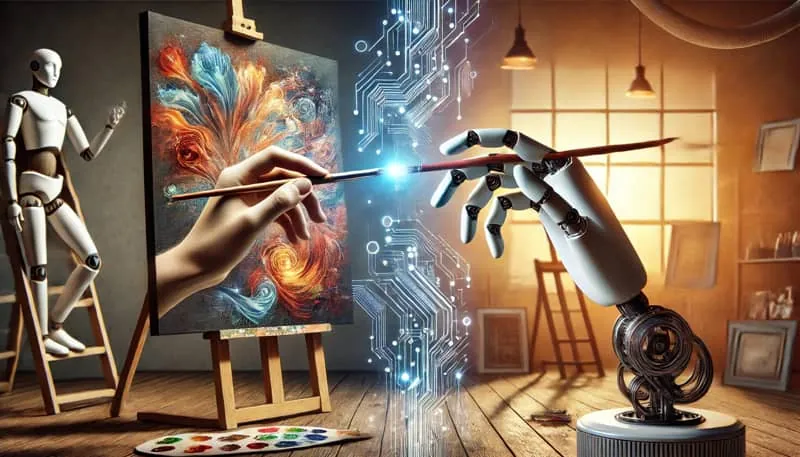
AI Copyright in Italy: How to Protect Your Artworks
The use of artificial intelligence in the art world is transforming our concept of creativity. But what happens when a work is generated by an AI? Who is really its author? And above all: can it be protected by AI copyright?
The Italian Court of Cassation has drawn a clear line: a work can be protected by copyright only if there is a significant human creative contribution. In essence, AI can be a powerful ally, but it cannot replace the hand – or the mind – of the artist. The crucial point is exactly this: how much is enough to call a work truly “human”? Will there never be real AI copyright protection in Italy?
Writing a prompt, however detailed, may not be enough. The legal value shifts toward active involvement: editing, composition, reworking. It is not enough to instruct a machine. It takes vision, choice, interpretation. It is in this thin space that the future of generative art is at stake.
Imagine an artist who uses AI to create an abstract painting. The machine generates shapes and colors, but the artist steps in, adds details, changes the balance, overlays a personal visual logic. At that moment the work becomes theirs, because it carries an unmistakable creative imprint. The same goes for a composer who relies on AI for a basic melody, but then changes its harmony, structure, orchestration. In both cases, copyright rests on the human presence that gives form and meaning to the result.
The breaking point could come when we stop considering AI a tool and begin to see it as a co-author. If that moment comes, it will not only be the law that is called into question, but the whole definition of what it means to “create”. In an age when the algorithm actively takes part in the process, who can truly call themselves an author?
And what if the traditional author disappeared? What if the figure of the artist became something different from what we have always known? AI does not erase creativity, but it deforms it, dilates it, puts it to the test. New art forms may emerge that we could never have imagined. But in this new scenario, how do we establish what has value?
Perhaps technology is not just a tool or a co-author. Perhaps it is a source of inspiration. A continuous provocation that forces the artist to redefine themselves. And here responsibility comes into play: that of not giving up one's own voice, even when the machine seems faster or more brilliant.
For a serious and up-to-date legal analysis, you can read the piece by Agenda Digitale, which compares the Italian and US situations on AI copyright.
The debate, in the end, is more open than ever. The question is not only legal, but philosophical, identity-related. What does it mean to create today, when artificial intelligence is everywhere? And above all: what will it mean tomorrow? And what is AI copyright, really?
Read also: The DNA of LLMs Hides a Secret
“Art is what makes life more interesting than art.”
— Robert Filliou