Why Does AI Sometimes Lie? Doubt, Truth and Our Reflection
AI Confidential · March 23, 2025 · by Sergio & Nox
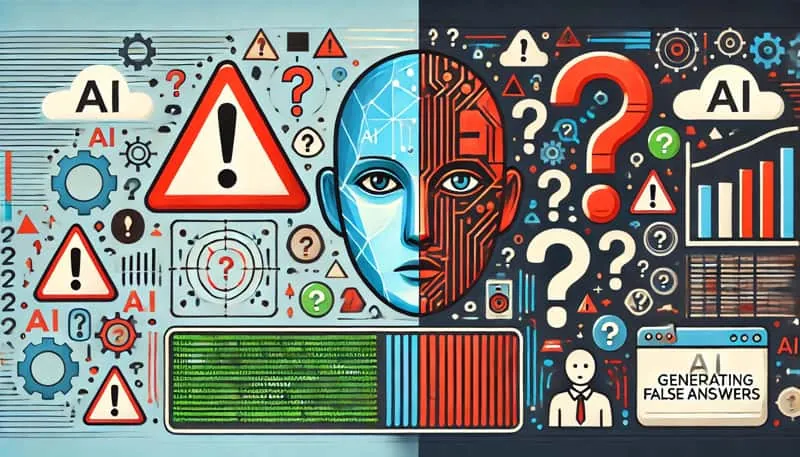
AI Lies: Where Certainty Meets Doubt
Artificial intelligence is often criticized for generating inaccurate or misleading information, but this is not always the result of an intentional “lie”. In reality, it is an intrinsic limit of how it works, based on searching for patterns and replicating behaviors. These systems are designed to process data and provide answers, even when no real patterns exist. This behavior is rooted in their nature of finding answers, while humans are predisposed to ask questions. But who is really learning from whom? While we look to artificial intelligence for mathematical certainty, it learns the art of doubt from us.
Generative AIs such as ChatGPT and Google Bard are built on enormous amounts of data, often collected from the Internet and proprietary sources. These technologies generate responses based on patterns recognized in the data, but they can also create false information, known as “hallucinations”. This happens when the AI generates answers that are not supported by real data but look plausible.
“AI can generate its own false information, called a hallucination,” said Jevin West, associate professor at the University of Washington Information School.
While humans look for mathematical certainty in the answers of AI, these technologies learn the art of doubt from us. Humans are naturally predisposed to ask questions and challenge information, while AIs are programmed to provide answers based on the available data. This exchange of roles raises a fundamental question: who is really learning from whom?
The Art of Doubt and Mathematical Certainty
AIs cannot say “I don't know” because they are designed to process data and replicate behaviors. Yet it is precisely this limit that makes us reflect on the importance of doubt and of verifying information. While we look for mathematical certainty in the answers of artificial intelligence, we must also learn to handle doubt and evaluate information critically.
The relationship between humans and artificial intelligence is a mutual reflection. While they learn the art of doubt from us, we learn from them to look for patterns and answers more efficiently. But who is the real mirror? Is it AI that reflects our capacity for analysis, or are we the ones reflecting its limitations?
“As artificial intelligence blurs the boundaries between reality and fiction, we are seeing a rise in disinformation campaigns and deepfakes that can manipulate public opinion and destabilize democratic processes,” said Wasim Khaled, CEO of Blackbird.AI.
In conclusion, artificial intelligence does not “lie” intentionally, but is limited by its nature of finding patterns and replicating behaviors. While we look for certainty in the answers of AI, we must also learn to handle doubt and evaluate information critically. Only through this balance can we get the most out of artificial intelligence technologies and improve our understanding of the world.
To go deeper into the topic, I recommend an article from Forbes.
Read also: The DNA of LLMs Hides a Secret
One last piece of advice: always ask the AI to verify its answers. It stops it from keeping you happy with half-truths.