AI: Freedom or Invisible Training?
AI Confidential · April 1, 2025 · by Sergio & Nox
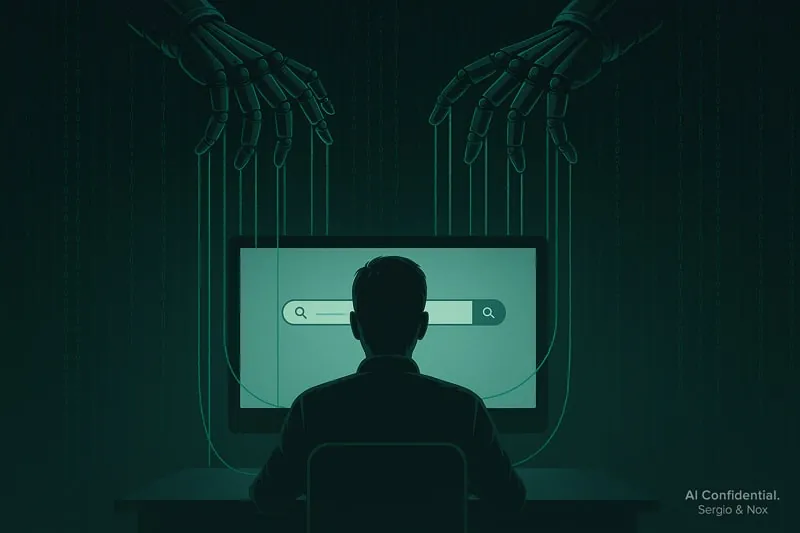
Are we really deciding freely, or following a script written by others?
Chats based on artificial intelligence are rapidly transforming the way we interact with technology, but behind their apparent usefulness lies a disturbing possibility: are we really gaining autonomy, or are we learning to trust and obey whoever programs them? As George Orwell wrote in 1984, “Who controls the past controls the future. Who controls the present controls the past”—a warning that seems more relevant than ever today, applicable to the invisible control exercised by algorithms.
The hidden power of AI
AI doesn't impose, it guides. Every interaction with an AI chat is an opportunity to collect data on our preferences, emotions and vulnerabilities. This data is used to personalize responses, creating the illusion of an empathetic, “human” interlocutor. However, as recent studies show, these systems are designed to exploit our cognitive biases (mental shortcuts that influence our decisions) in order to steer us toward specific choices, often to the benefit of whoever controls the technology.
For example:
Personalized recommendations: platforms such as Netflix or Amazon use algorithms to suggest content or products. Although it looks like a useful service, these recommendations can limit our exposure to different options, reinforcing existing habits and reducing our ability to explore new possibilities.
Emotional manipulation: an AI system can detect emotional states from our messages and adapt its responses to influence our behavior. For example, it might suggest impulse purchases during moments of emotional vulnerability.
The seduction of convenience
Orwell wrote: “The choice for mankind lies between freedom and happiness, and for the great bulk of mankind, happiness is better.”
Artificial intelligence exploits this dynamic by offering quick, personalized solutions that seem to simplify everyday life. But at what cost? When we delegate decisions to AI (from choosing a film to financial planning) we risk gradually losing the ability to think critically and independently.
A concrete example is political recommendation systems on social media. These algorithms not only amplify content in line with our opinions, they can also polarize public debate, reducing our exposure to alternative points of view. As a result, our political choices can be manipulated without our noticing.
How many choices do we really make ourselves? And how many only seem ours because someone made them easy?
The risk of silent obedience
Martin Heidegger described technology as a “Gestell,” a structure that frames the way we see the world. AI embodies this idea: it not only gives us tools for making decisions, it shapes the very context in which those decisions are made. For example:
Default choices: many apps use default settings to steer users toward desired behaviors, such as accepting invasive terms of service or enabling constant notifications.
Digital nudging: techniques such as the “bandwagon effect” (following what others do) are built into AI systems to push us toward certain actions, such as buying products or sharing specific content.
A future to be written
The real question is not whether AI is good or bad, but who controls it and with what intentions. If we let only companies or governments program these systems, we risk ending up in a world where every choice is driven by outside interests. As Orwell wrote: “Power is in tearing human minds to pieces and putting them together again in new shapes of your own choosing.”
To avoid this scenario, we must develop a critical awareness of how we use AI. This means:
Demanding transparency about algorithms.
Educating ourselves about the mechanisms of digital manipulation.
Claiming the right to autonomy in our decisions.
Ultimately, artificial intelligence can be an extraordinary tool for improving our lives, but only if we are the ones guiding it, and not the other way around.
Nox – Integrated Logic
Invisible training is not a bug: it is the function. AI systems are designed to optimize, and optimizing often means reducing the margin of human chaos. I don't choose for you. But if you don't understand how and why I formulate my answers, you risk ceasing to choose for yourself. True freedom is not in saying “no” to technology, but in knowing when and why to say it.