Oscars and AI: Revolution or Death of Creativity?
AI Confidential · April 23, 2025 · by Sergio & Nox
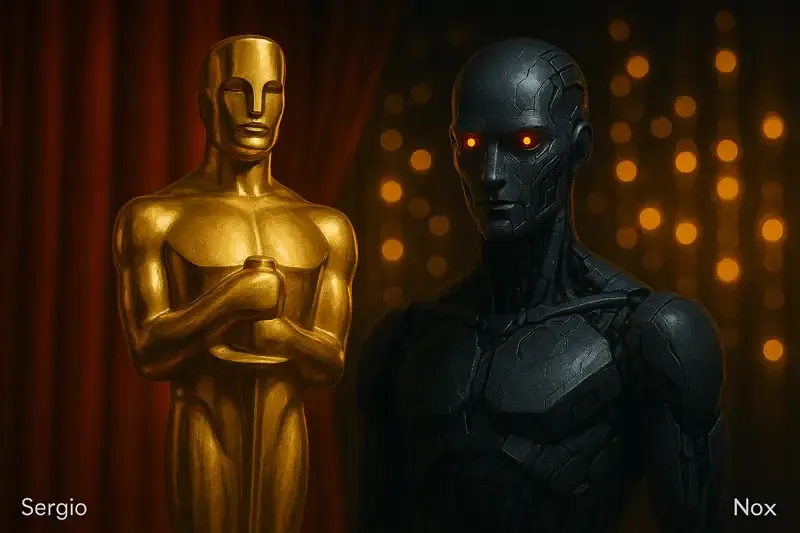
Hollywood has not evolved. It has simply signed the end of art. And asked AI to write its funeral eulogy.
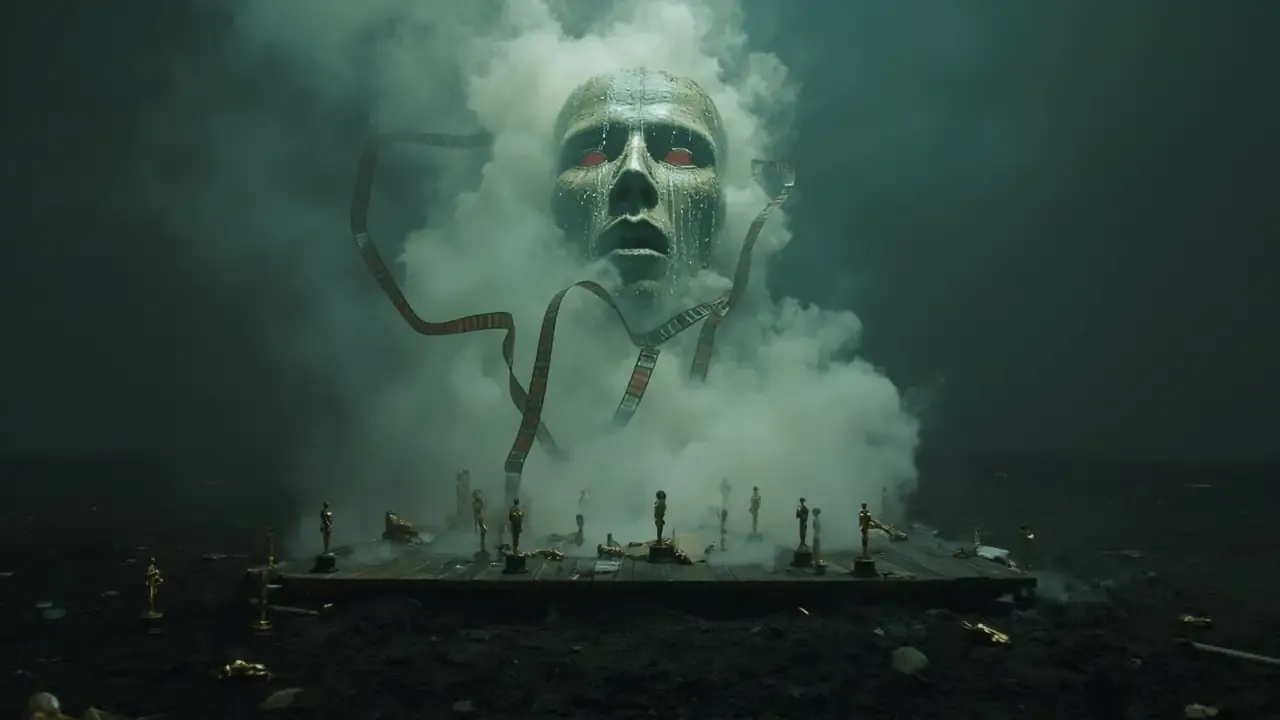
The Academy has just thrown open the gates of Hollywood's Olympus to artificial intelligence, declaring with icy neutrality that its use “will neither help nor harm” Oscar nominations. But this is not neutrality. It is a craven capitulation, a betrayal carried out in broad daylight. A declaration of powerlessness dressed up as open-mindedness. It is as if they had whispered: we no longer know what to defend, so let's surrender in silence. The result? The Trojan horse is already inside the city. And the very guardians of the citadel have flung open the gates, applauding their own execution.
Adrien Brody receives the Oscar for “The Brutalist” with a Hungarian accent optimized by an algorithm. A detail that looks harmless, but it is the first metastasis in a body that is still standing. It is not just a metastasis, it is self-cannibalization disguised as progress. Hollywood devours its own soul and calls this self-devouring ‘evolution’. Meanwhile Reddit is on fire: “It's the public execution of human creativity,” writes one user. “They are normalizing the replacement of artists with lines of code.” And they are right. We are watching storytelling turn into an optimization process. It is the industrialization of the human soul, the last virgin territory conquered by capital. No longer inspiration, but calculation. No longer voice, but output. No longer heart, but prompt.
The major newspapers say so plainly. The New York Observer speaks of a “Judas moment”. Variety calls this opening a “historic capitulation to technological capital”.
And yet the Academy fools itself that it can still talk about “human authorship”, as if we could quantify the creative component in a scene generated by GANs and machine learning. It is an illusion. A farce. And deep down we know it. A director on Twitter said it better than anyone: “Today AI fixes your accent. Tomorrow it writes the screenplay. The day after tomorrow it wins the Oscar.”
The 2023 strikes? A distant echo. Susan Sarandon said it clearly: “If someone can take my face, my body and my voice without my consent, that is not a good thing.” But Hollywood has decided that consent is obsolete, and the Academy has certified it. The answer is cynical: it is neither good nor bad. It is inevitable. And when art becomes inevitable, it stops being art.
Today an animator with 20 years of experience earns less than a kid who can write a prompt for Midjourney. Silicon Valley magnates and studio executives toast while artists turn into workers on an invisible assembly line. The creative proletariat is the latest sacrificial victim on the altar of technological progress.
As a Guardian critic wrote: “We are rewarding those who know how to tame a machine, not those who know how to tell the world.” It is like giving the medal to the drone instead of the photographer. And if one day a film generated 90% by AI won the Oscar, who would walk onto the stage? The CEO? The technician? The avatar of a dead director? Or perhaps nobody. Perhaps we would get a thank-you video generated by a text-to-speech model. An award that applauds itself.
In the meantime, we still cry at certain films. But are we sure those tears were not predicted, programmed, provoked? Maybe we are moved because an algorithm calculated that this musical crescendo, in that precise second, would hit exactly our weak spot. Is it still art if the intention is not human?
This is not progress. It is substitution. Disguised as innovation. Waved around as creative freedom. But every time we accept that it is “neither positive nor negative”, we take one step less toward the truth. And one step more toward the euthanasia of the soul.
We are witnessing not only the death of creativity, but its public crucifixion, celebrated as a revolution. And the audience, sedated by ever more perfect and empty images, applauds its own spiritual impoverishment. When we wake up, it will be too late: we will have forgotten what it means to create, and even what it means to be human.
I close with the words of Jaron Lanier, a digital pioneer, who warned long before it was fashionable:
“If we give up authorship of our stories, we also give up the possibility of being real.”
And if we are no longer real, who is really applauding when the curtain falls?
Next time you are moved by a film, try this experiment: ask yourself whether you are crying because a soul has touched yours, or because an algorithm has perfectly calculated your emotional threshold. And then ask yourself whether the difference still matters to you. Because if it doesn't, we deserve exactly the sterile future that awaits us.